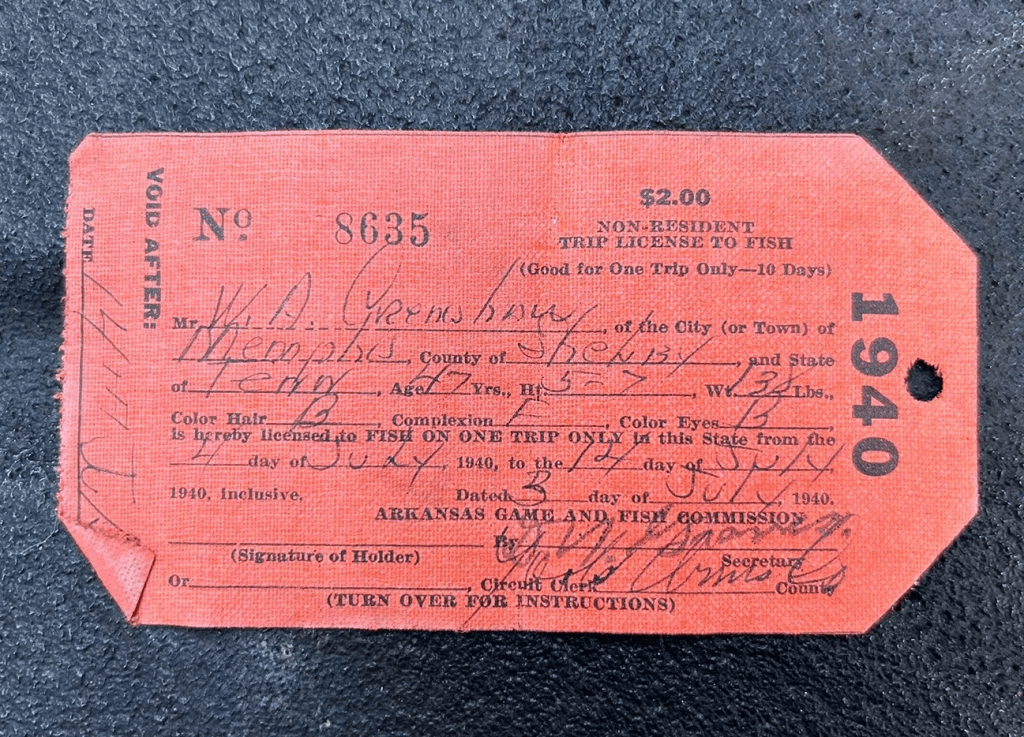
Picture of a 1940 Non-resident license
Arkansas passed the first statewide non-resident hunting laws in the nation. A direct shot at market hunting. Approved on March 6, 1875, the Non-Residents License Law stated that “a tax of ten ($10.00) dollars is hereby levied upon all non-resident trappers, hunters, seiners, or netters of fish…in this state.” The state charged ten dollars, payable to the county clerk, to any non-resident who wanted to trap or hunt in Arkansas. If non-Arkansan failed to obtain a license and were caught, the state charged them with a misdemeanor and fined them twenty-five dollars. However, the act contained no language about how the law was enforced or who would enforce it. Physician and early amateur ornithologist William H. Deaderick claimed the law, “at least at first, [gave] greater protection to the native pot hunter than the birds”. He blamed the law for the cause of so many market hunters becoming Arkansas residents in the following years.[1]
Rumblings over the law continued for some time afterward. A decade later, a letter from Carlisle to the editor of the Arkansas Democrat scolded the paper for reporting that many Arkansawyers wanted the license law repealed. “It should by no means be repealed,” the letter claimed but made more stringent instead. For many years, travelers viewed game in abundance throughout the countryside, but “not a few years of invasion of the ‘pot hunters,’ who think not, nor cared, for the final results of their destructive methods, have well nigh destroyed it all.” The man from Carlisle argued that since the passage of the license law, the game had multiplied, and he credited the legislation directly for the results. Arkansas needed more game laws, not fewer, he believed.[2]
Theodore S. Palmer, Assistant in Charge of Game Preservation for the United States Department of Agriculture, wrote in 1900 that with this law, Arkansas was a “pioneer in the restrictions on market hunters.” Unfortunately, circuit court judges in both Craighead and Poinsett counties ruled the 1875 license law unconstitutional in 1887 after an Indianan, M. Adaml, sued the local sheriff. The Poinsett County ruling caused Sheriff Harris to remit the ten-dollar fee to eighteen individuals who had paid him for the licenses. Evidently, he had “enforced it vigorously and collected hundreds of dollars from sportsmen.” Not many county officers were enforcing the law anyway (with one exception), and few non-residents knew of the law.[3] The Southern Standard in Arkadelphia called the court ruling “common sense, at least.” It continued, “Now let the law be amended so as to sharpen and ensure the punishment of pot-hunters.”[4]
[1] Acts, Resolutions, and Memorials of the General Assembly of the State of Arkansas (Little Rock: William E. Woodruff, Jr, 1875), 176-177, 250; William H. Deaderick, “A History of Arkansas Ornithology,” The American Midland Naturalist Vol. 26, No. 1 (July 1941), 207-217, 10. Dr. William Heiskell Deaderick practiced medicine in Marianna, Arkansas, and Hot Springs. He published several books and journal articles on malaria and syphilis, but he was also an amateur ornithologist and fossil hunter. His foraminifera collection is preserved at the Smithsonian.
[2] “The Game Law,” Arkansas Democrat, January 27, 1887, 8; For more on the continued argument to repeal the law, see Arkansas Democrat, February 5, 1887, 4.
[3] T. S. Palmer, “Hunting Licenses: Their History, Objects, and Limitations,” Washington, Government Printing Office, 1904, 14; The American Field, Vol. 27 (January 15, 1887), 49; The American Field, July 2, 1887, 3-4. The American Field, January 15, 1887, 1.
[4] The Southern Standard, January 22, 1887, 7.
 Arkansas Wildlife History