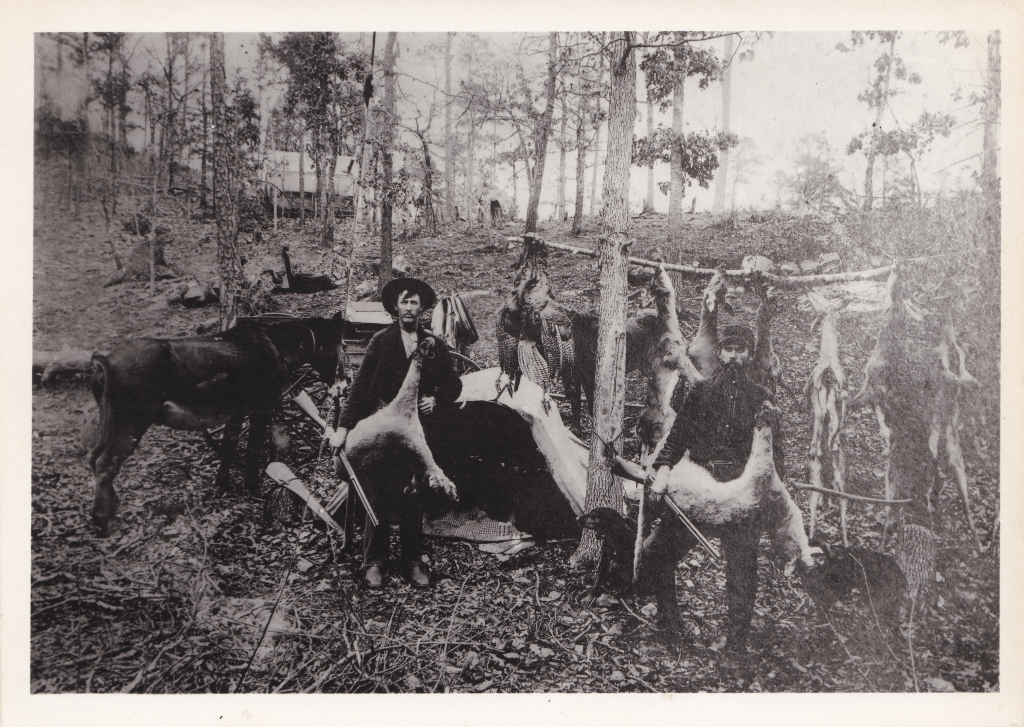
Market Hunters near Mena, Arkansas. Univ of Arkansas Special Collections.
In his study of the Buffalo National River, historian Theodore Catton explained that the Ozark fur trading went through three different phases. Native American hunters brought the peltries to European-established trading posts on a waterway with access to New Orleans or St. Louis via the Mississippi River. In some cases, the pelts made their way to the international market via these more important trading centers. In the next stage, European hunters sometimes competed and sometimes cooperated with the Native Americans and visited the same trading posts to exchange their harvests. These hunters lived a nomadic lifestyle, hunting an area for a few seasons and chasing more plentiful areas. The final stage was when the American hunter established a more permanent base of operations, farming a few acres, raising families in a dwelling, hunting to feed the family, and trading for essential manufactured goods. To understand Arkansas, we must begin with the environment.[1]
[1] Theodore Catton, “Life, Leisure, and Hardship Along the Buffalo,” (Historic Resource Study, Midwest Region, National Park Service, Omaha, Nebraska, 2008), 51.
#arkansas #arkansashunting #rabbithunting #huntingdogs #earlyarkansas #arkansaswildlife #snowhunting #huntingdog #vintagehunting #vintagepicture #authenticarkansas #huntingishistory #arkansashistory #arkansaswildlifehistory #arkansasoutdoors #thenaturalstate #arkansaswildlife #earlyarkansas #huntingishistory #environment #vintagehunter #vintagehunting #vintagehunting #envhistory #animalhistory #huntinglicense #wildlifeconservation
 Arkansas Wildlife History