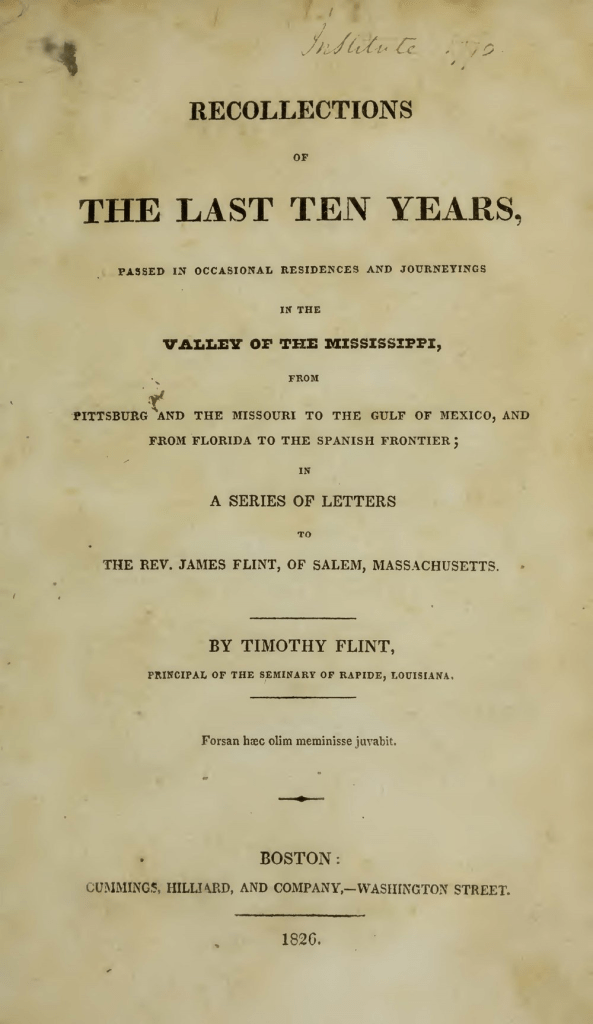
Reverend Timothy Flint claimed that “the western states are already comparatively populous. The tide having there found its level continues to roll on, eddying, disparting, and finding its secret currents into every and valley of the wilderness. The smoke of hearth arises, and man with his axe, gun, and human incitements to action, is there.” Unfortunately, the minister of the gospel was not impressed with the type of people emigrating into Arkansas.“It is much to be regretted so great a proportion of the emigrants are of the class poor vagrant and worthless foreigners the scum of despotic governments unacquainted with our institutions,” he judged. Reverend Flint had previously visited the Arkansas Territory in 1819. He claimed to have met the same type of people then. The people have the “same disregard of severe industry and municipal habits. They dance and sing and live in a village–hunt and fish and are content with a little.” [1]
In 1835, Flint was astonished to see so many people living so far out into the wilderness along the Ouachita River. “How rapidly the remotest frontier forests of our country are filling up with the current of the westward tide of emigration,” he explained. These small remote communities of 1835 still lived very much like they had fifty years previously. Flint called it a combination of “hunter’s, soldier’s, and woodsman’s life, sprinkled with French gallantry and Spanish romance.” Clearly, many Arkansawyers continued to hunt and fish to feed their families.[2] Despite Flint’s condemnation, the transition to a more agrarian-based livelihood had begun in other state regions.
A Tennessee editor claimed that “lawless freebooters, infesting the Arkansas shore of the Mississippi some hundred miles,” steal “horses, negroes, cattle, and every species of property.” These perspectives were because economic evolution did not occur evenly, and the state remained isolated in many ways. Lawless gangs and thieves did run some of the swamps and isolated hollers.[3]
[1] “Journal of the Rev Timothy Flint,” 284-288.
[2] “Journal of the Rev Timothy Flint,” 284-288.
[3] Arkansas Times and Advocate, October 16, 1835, 1; Randolph Recorder, June 20, 1834.
 Arkansas Wildlife History