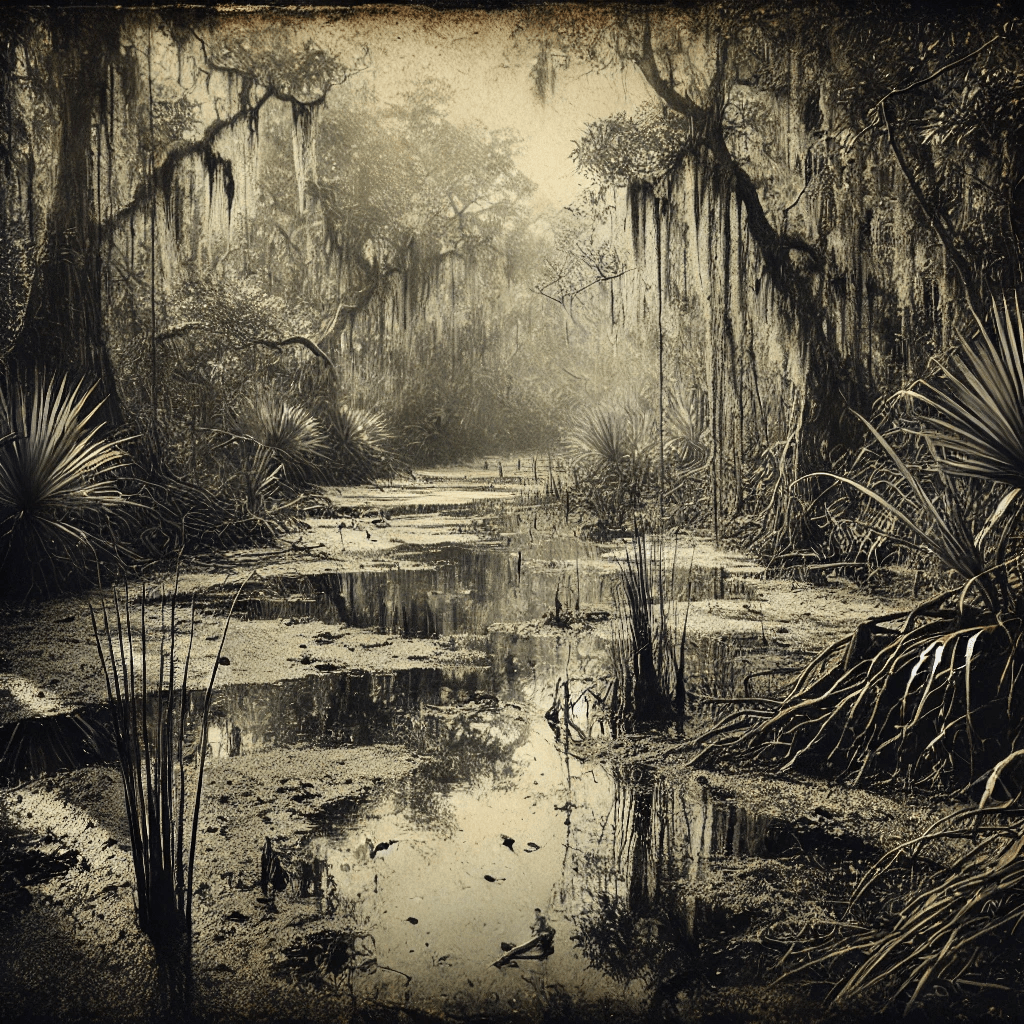
The overflow land of the Mississippi, Presbyterian missionary Timothy Flint explained in 1819, contained “immense swamps of cypress,” and the water of these swamps was “covered with a thick coat of green matter,” filled with the “moccason [sic] snake with his huge scaly body lying in the folds upon the side of a cypress knee.” The enormous cypress, hundreds of years old, often towering well over 125 feet, covered and tangled the swamps and bayous along the rivers. Millions of mosquitoes swarmed, attacked, and menaced the traveler. Only the most experienced (or desperate) men would travel into these daunting, dark, and seemingly endless waterways. Once winter ended and warm weather began, mosquitoes and heat tormented the Flint family everywhere they visited in Arkansas, “The air was excessively sultry, and the musquitoes [sic] troublesome to a degree, which I have not experienced before nor since.” The annoyance proved unbearable; travelers and locals drank enough liquor “to produce a happy reverie, or a dozing insensibility.” Drinkers called this amount of liquor “a musquitoe dose.” Before the family could cook a meal, they started a smoky fire to drive the swarms away. These pests proved more than a nuisance. They could kill.[1]
In 1820, “OSCAR” wrote to the Arkansas Gazette at Arkansas Post, blaming the general sickness of inhabitants on something other than mosquitoes or “bad air. The fever and ague, which has heretofore been prevalent among the people, was, doubtless, rather owing to their mode of living than to any baneful properties of the atmosphere.” He spoke with several neighbors, who claimed that they “uniformly enjoyed better health in this country, than in the middle or southern states, where they formerly resided.” For Oscar anyone saying that Arkansas had bad soil and sickly air was simply spreading rumors so that they could buy land in the territory at reduced prices. Another Arkansawyer agreed, “The country back from the river has remained quite healthy, especially families living right out on the prairie, so far as I have observed, have been entirely healthy.”[2]
In the 1870s, sportsman Farran Wyde compared Arkansas and Mississippi’s general population and appearances. He claimed he had hunted on both sides of the Mississippi for several years, but he preferred the east side because of uncouth people who resided on the Arkansas side. “Many a weary mile have I ridden in search of a cup of cold water, and often I have been turned away from rude cabins and log huts almost always with the same answer—a scowl and a slam of the rickety door,” Wyde sadly explained. The hunter had an idea why Arkansas people were so impolite, however. He hypothesized that it was because of the “sickness prevailing among the people, for all seemed to be wan and yellow, worn out and shaking with fever and ague.” Another likely explanation was a distrust of strangers because of the violence and hardships that many rural Arkansawyers experienced during the Civil War less than ten years before. Possibly, they were also tired of seeing non-residents come into Arkansas and kill game that residents believed was rightfully theirs.[3]
At night, only partially effective remedies existed to ward off mosquitoes. Flint slept under what he called a “very close musquitoe [sic] curtain. When I drew it up and attempted to inhale a little of the damp and sultry atmosphere, the musquitoes [sic] would instantly settle on my face,” evidently having difficulty breathing under most likely a sheet of muslin. Fifty years later, a lower White River valley visitor claimed the area remained “a wooded wilderness of fever nests and mosquito pests.”[4]
[1] Flint, Recollections, 261-262, 272, 273. Bald Cypress trees (Taxodium distichum) can live to 600 years, although some are recorded at over 2000 years old. For more information, see “At 2,624 years, a bald cypress is the oldest known living tree in eastern North America,” https://news.mongabay.com/2019/05/at-2624-years-a-bald-cypress-is-oldest-known-living-tree-in-eastern-north-america/, accessed June 15, 2021; “Journal of the Rev Timothy Flint,” 284-288. By 1835, timbermen were floating huge cypress trees down the Ouachita from Ecor a Fabre (Camden) to a steam-powered sawmill on the Red River, over 300 miles.
[2] “For the Arkansas Gazette,” The Arkansas Gazette (Arkansas Post), May 27, 1820, 3.
[3] “Winter Sport in the Mississippi Bottom,” Forest and Stream, December 17, 1874, 1. To learn more about Arkansas’s resistance to authority, see J. Blake Perkins, Hillbilly Hellraisers: Federal Power and Popular Defiance in the Ozarks (Chicago: University of Illinois Press, 2017).
[4] Flint, Recollections, 272; Sam Black, A Soldier’s Recollections of the Civil War (Minco, OK: 1912), 16.
 Arkansas Wildlife History